The Norebo sanctions are based on manipulation from NRK
The Norwegian government has chosen to follow the EU Commission in sanctioning the fishing company Norebo. The sanctions are based on speculations in the press and the EU Commission is open about the fact that it does not care to verify whether the allegations are true.
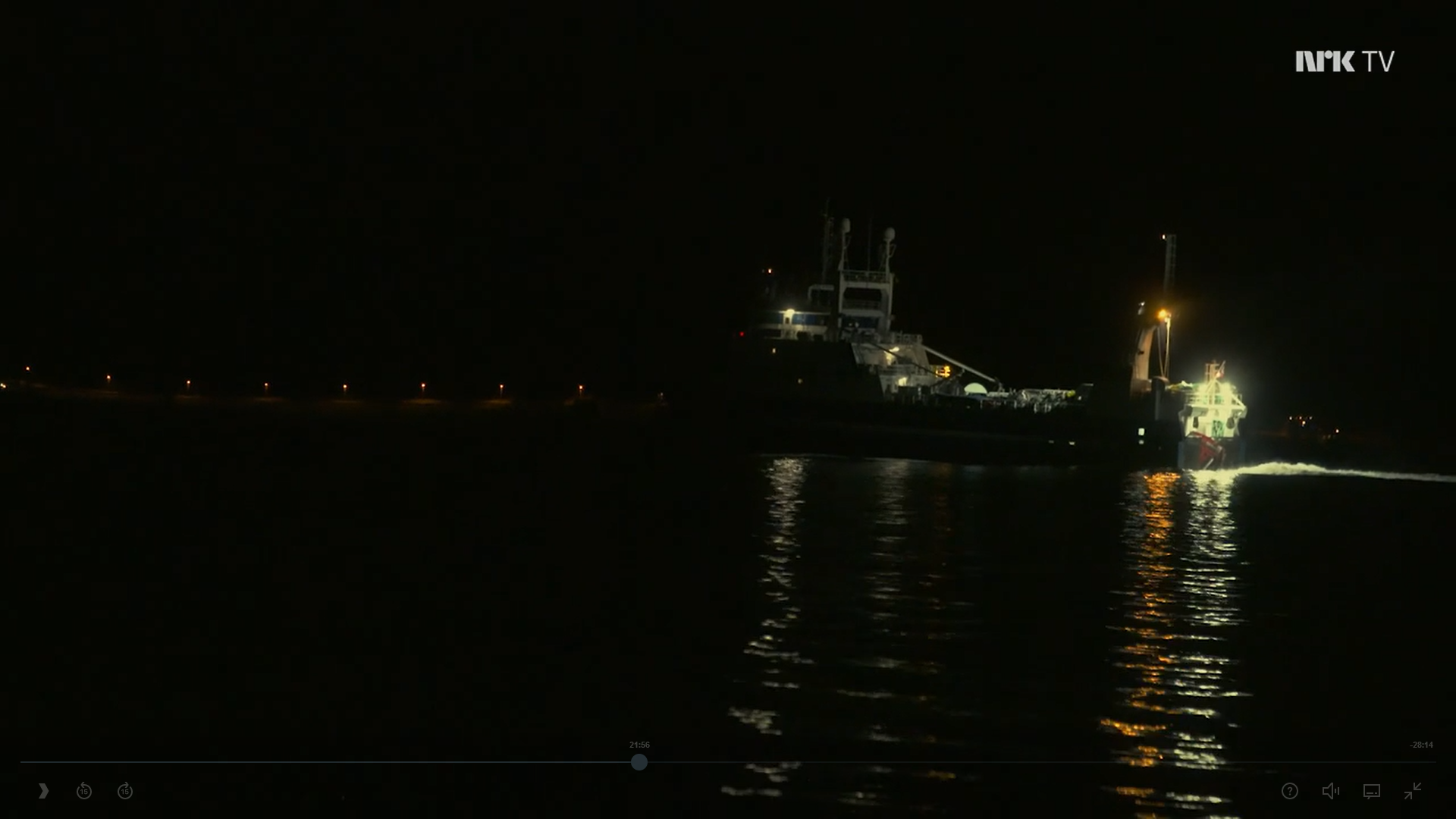
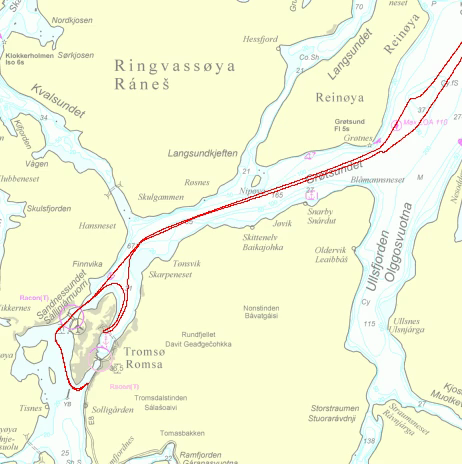
Picture from NRK “The Shadow War”: December 2022, the trawler Taurus is passing the nuclear submarine USS South Dakota, which is moored at the municipal quay in Tønsnes. Can you spot the submarine at the quay?
In connection with the deliberations of the sanctions against the Russian trawler company Norebo in the Faroese Parliament,1 the company sent a letter to the Foreign Affairs Committee.2 Norebo had asked the EU Commission for access to the material on which the accusations against them of espionage and sabotage were based.
The response Norebo received was an evidence package with 18 news articles, nothing else. Several of the articles were machine translated. The EU Commission also stated that in the absence of investigative authority in third countries, the EU authorities had to rely on publicly available information, reports, press articles and the like.
Norebo included a summary of the five main allegations against them in the letter to the Parliament: The Norwegian public broadcaster NRK’s claim of espionage by the trawler Taurus, the allegations that the trawler Kapitan Sokolov had assisted the Chinese vessel NewNew Polar Bear in damaging the Balticconnector pipeline, the speculation that the freezer ship Belomorye had operated in a suspicious manner near the gas terminal in Nyhavna in Norway, that the freezer ship Canopus had performed suspicious maneuvering over gas pipes off the Netherlands, and that the old radios found by the Norwegian police aboard the trawlers Ester and Lira in Kirkenes could be used for espionage.
I asked the lawyer representing Norebo if they were willing to share the “evidence list” from the EU Commission. The Commission had placed restrictions on sharing the assessments they had made of the articles, but there was nothing preventing sharing the list of articles itself.
In addition to examining the items in the summary from Norebo, I have also looked into the claim that a Norebo vessel was banned from Dutch ports due to espionage, and the allegation that Russia is running a sabotage campaign in the Baltic Sea.
The primary sources for the espionage allegations against the Norebo are the public broadcasters in Norway (NRK), Belgium (VRT NWS) and the Netherlands (KRO-NCRV/Pointer), as well as the Norwegian news outlet “The Barents Observer” and the Dutch investigative magazine “Follow the Money”. The other articles about espionage activities from the Norebo vessels are reproducing the material from these sources.
I have reviewed the articles that the EU Commission has used as evidence and it is astonishingly easy to show that all the suspicions, allegations and accusations are unfounded and wrong.
When drafting the Norwegian Sanctions Act, there were concerns that sanctions Norway agreed to join could be implemented without a sound legal basis.3 To prevent arbitrary punishment - sanctioning - the Act includes a safety valve, the opportunity for the sanctioned party to complain to both the Ministry of Foreign Affairs (MFA) and the government, as well as to file a lawsuit to be removed from the sanctions list.4
The EU Commission does not seem to be bothered to investigate whether the suspicions and accusations are real. Another Russian fishing company, Murman Seafood, was sanctioned on similar grounds. They filed a complaint with the Norwegian Ministry of Foreign Affairs on November 14 and are prepared to take legal action if necessary, according to Deputy Director Andrey Roman.5
It is unlikely that the Russian fishing companies are not going to prevail if they go to court. If you want to know how I can be so sure - read on:
NRK: “The Shadow War”
At the DataSKUP journalist competition in 2024, the fishing newspaper “Kyst og Fjord” presented work showing that NRK in the series The Shadow War had manipulated the presentation of the trawler Taurus and that NRK lacked basis for their claim that 50 Russian ships could have been engaged in espionage.6 We also showed that the claim that the police had found military radios on Russian trawlers was dead wrong.7
Afterwards, NRK quietly changed around 20 articles where they previously claimed that “NRK uncovers Russian intelligence from vessels - here the police found military radios”. This text was removed, documentation of what transpired is shown in the appendix section of the reference, a complaint sent to NRK.8 They also changed an article where they clarified: “In an earlier version of this article it was stated that NRK has revealed several cases of espionage from Russian vessels. The correct statement is that NRK has revealed that 50 Russian civilian vessels may have been conducting espionage in Norway.”9
Strangely, NRK still claimed that they had “revealed that 50 civilian Russian vessels may have been engaged in espionage”. This was despite the fact that we had documented completely normal explanations for all the AIS tracks that NRK claimed were inexplicable, and by that, reason to suspect espionage. There is nothing distinguishing the tracks claimed to be suspicious by NRK from the tracks left by all other Russian ships anymore. The basis for the claim was gone, but surprisingly, it had no bearing on the conclusion. The editor just changed the justification.
To support his view, the editor used the Russian maritime doctrine from 2022 and claimed that it was a threat that many Russian sailors had a Norwegian “fairway certificate”.10 However, only three of the AIS tracks out of the 50 vessels that NRK claimed could have conducted espionage were from the time after the doctrine was published. These three vessels were even inspected by Norwegian authorities without any suspicious findings.8 The assumed threat from Russians with a fairway certificate was that they could use their knowledge of Norwegian internal waters in a possible future conflict.11
However, the doctrine cannot have been the cause of any espionage activity that allegedly took place before it was released. And the possible future threat from Russians with a fairway certificate cannot justify espionage that has already taken place. The editor’s reasoning is not rational.
NRK was present with the editor and a journalist at DataSKUP to respond to our criticism. They had no objections or comments to the findings. The journalist, Håvard Gulldahl, said that he wished that they had knowledge of what was shown when they started the project.12
NRK: The trawler Taurus
NRK published five images with allegedly suspicious AIS tracks and made great effort in making it look suspicious when the trawler passed the nuclear submarine USS South Dakota in 2022. NRK launched their own “mission” shadowing the vessel out of port and past the submarine in their own little boat.
December 2022 - USS South Dakota: “It is dark and difficult to see if Taurus has been spying on the submarine. Was this a successful intelligence operation? What is certain is that Taurus is sailing close enough to the submarine that they can see it, take pictures, or maybe even try to eavesdrop”, the NRK journalist said in “The Shadow War”.
What the journalist did not say was that NRK manipulated the AIS tracks they showed and shot the footage much closer to the trawler than where the trawler actually passed to make it appear suspicious. In the article “The Spy Ships”, NRK also claimed that the coast guard vessel “KV Bison” had met with Taurus in Tromsø and escorted the vessel past the submarine.13
I asked the Coast Guard if “KV Bison” had sailed to Tromsø to meet with Taurus as NRK claimed. The answer was no, the vessel had not done so. The vessel sailed to Tromsø to pick up a crew member.14
The NRK journalist just made up the story. It would have been incredibly foolish, though, if the Coast Guard had suspected that the trawler was attempting to spy on the submarine, and then dispatched a Coast Guard vessel to escort it past the submarine so that it could spy.
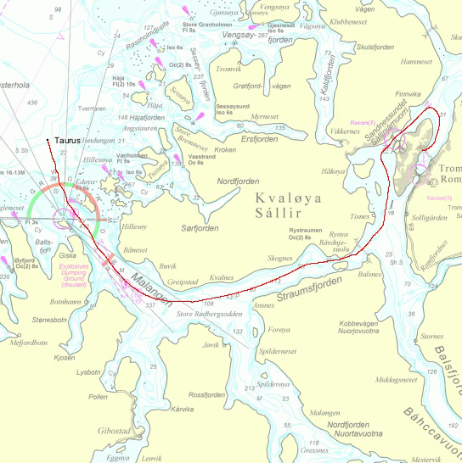
All foreign vessels must obtain permission from the Norwegian Armed Forces Operational Headquarters before sailing through the Norwegian territorial waters.15 There are two sea routes out of Tromsø and if the Norwegian Armed Forces had concerns about the Taurus spying on the “USS South Dakota”, they would obviously instructed the trawler to sail the other way, through the Malangen fjord.
The dispatcher on duty at Lødingen pilot station on the day in question confirmed that it was the pilot service itself that requested Taurus to sail without a pilot from Tromsø.16 The reason was a capacity problem. The dispatcher stated that it is standard procedure to ask vessels such as Taurus that are not required to use a pilot to help out.17
In the video below from the presentation we gave at the DataSKUP competition in 2024, we show in detail the manipulation NRK carried out to make the coverage of “Taurus” appear suspicious. This has previously been covered in detail both in the article “The spy ships: NRK’s investigative journalists publishing flawed evidence of Russian espionage”18 and in Kyst og Fjord’s presentation at DataSKUP.19
The EU Commission has listed both the TV series The Shadow War20 and the Spy Ships article in German “google-translate” version in its “evidence” list.21 In addition, they have included an article from the “Courthouse News Service”22 and an IntraShip article that uses the publications from NRK as a source.23
The IntraShip article specifically mention that Norebo acquired the Taurus in 2021 when they took over the fishing vessels of the Murmansk-based FEST group. The EU Commission appear to be very selective in the information they rely on in the press articles. They include all the activity of the Taurus that NRK claimed was suspicious from 2016, but ignore the information in the IntraFish article in their own “evidence pack” stating that Norebo acquired Taurus in November 2021.
The notion the NRK journalists have of the Taurus as an espionage vessel is strange. It appears like the journalists believe that the vessel itself is haunted and doomed to be spying regardless of who the owner or the crew is.
The footage published by NRK from their own boat, which sailed much closer to the submarine than the trawler itself did, also renders the allegation completely meaningless. The images NRK showed to the whole world are necessarily much better than those that in any possibly way could have been taken from the trawler far away.
When the NRK editorial team manipulated the presentation to arouse suspicion that a criminal offense had been committed, without this being the case, they crossed a line. This is a criminal offense.24
NRK has rejected repeated inquiries for comment and corrections, stating that they consider the case closed.8
What follows next is a brief walk-through of the allegations from NRK towards the Taurus from the period before the vessel was owned by Norebo. Maps with video and images of the AIS tracks are included in the references.
May 2021: NRK: “In the beginning of May 2021, an American nuclear submarine arrived in Tromsø. At the same time, the trawler «Taurus» was passing slowly by. First on the trip south, then when they sail north again the next day.” 25
Here NRK was sloppy. They claimed that the “Taurus” passed the American nuclear submarine both on its way south to Tromsø and north again the next day. This is not true. “USS New Mexico” arrived at Tønsnes, with its AIS transmitter on, after “Taurus” had passed Tønsnes on its way south. The arrival was widely covered in the Norwegian press, and the Norwegian Defense forces26 and the US Navy also published close-up photos of the submarine in connection with the visit.27
The AIS tracks show that the “Taurus” did not slow down during its passage as NRK claimed, neither when they passed on their way south without a submarine quayside, nor when they passed on the way north again, with a submarine at the quay and with a pilot on board.28
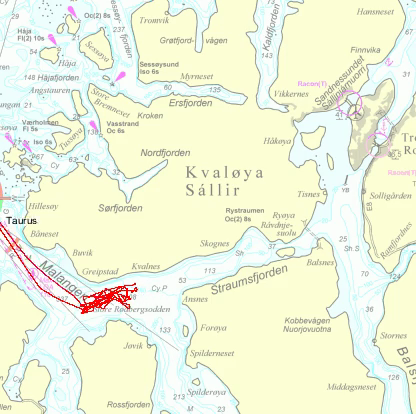
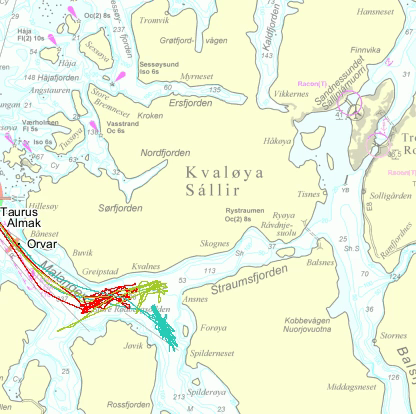
April 2021: NRK: “The red AIS tracks show that “Taurus” has entered the Malangfjord and circled there for 24-hours in mid-April 2021.”29
NRK showed tracks from “Taurus” in Malangen. Two other Russian trawlers also circled the fjord during the same period.30 The weather forecast for the area on this day in April 2021 was strong gales, poor visibility and rough seas.31
Following an inquiry to the Norwegian Armed Forces Operational Headquarters, they responded that the vessel had applied for permission to seek shelter in Malangen due to bad weather in accordance with current regulations. In the context of the prevailing weather conditions in the area, they considered the activity of “Taurus” to be part of normal navigation.32
March 2019: NRK: “The AIS tracks of the “Taurus” show that they are sailing out of Malangsfjorden and Hekkingen a few hours after an American nuclear submarine performed a crew change here at the end of March 2019.”33
“Taurus” was docked in Tromsø while the submarine performed the crew change with the MS Skaaskjær from Somarøya in the middle of the main fairway out of the Malangen fjord. The trawler arrived at the scene 9 hours after the submarine had left the area.34 NRK has not given any explanation as to what kind of information they believe it is possible that the trawler may have obtained.
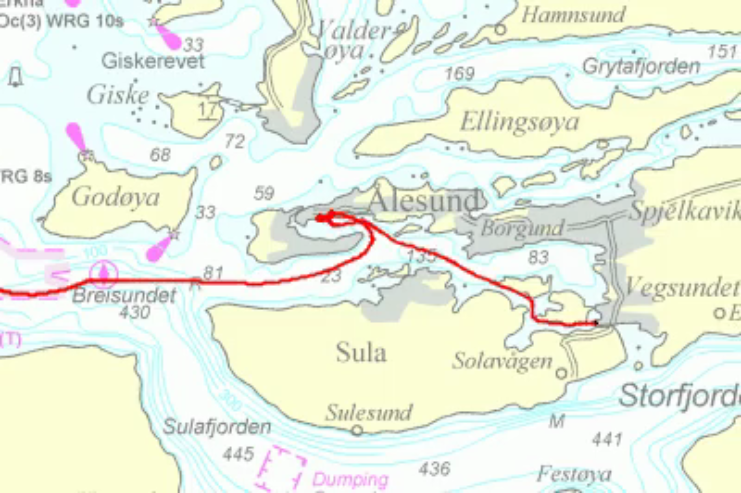
October 2018: NRK: “At one point, it appears that the “Taurus” interrupted the fishing and sailed directly to Ålesund. Coincidentally, there was a major NATO exercise in Trøndelag when the trawler passed.”35
The AIS tracks show that the vessel continued on from Ålesund to Vegsund, a few nautical miles east of Ålesund, and then into the floating dock at the Vegsund slip shipyard36. NRK has not given any explanation of what they believe the vessel could have done that is suspicious. The vessel passed well outside the radio horizon of the exercise area and could not even listen to radio communications.37
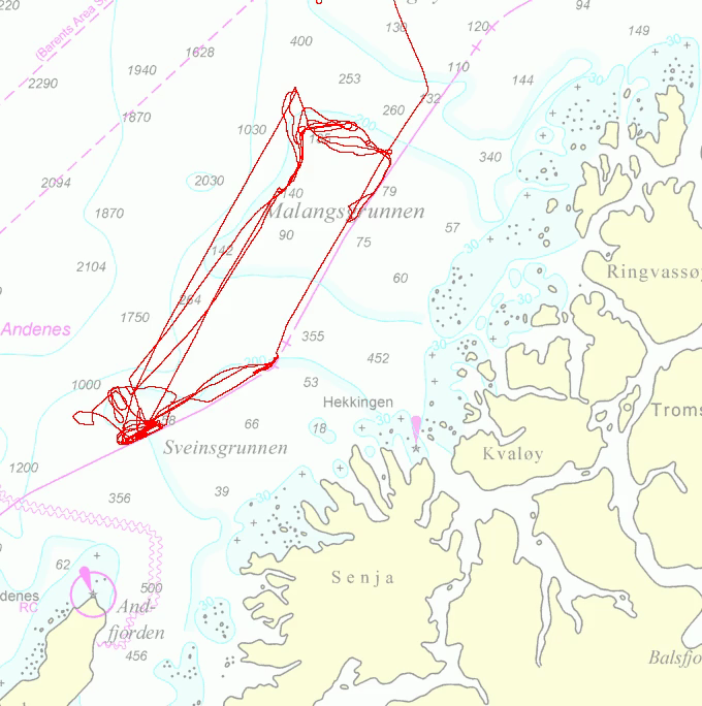
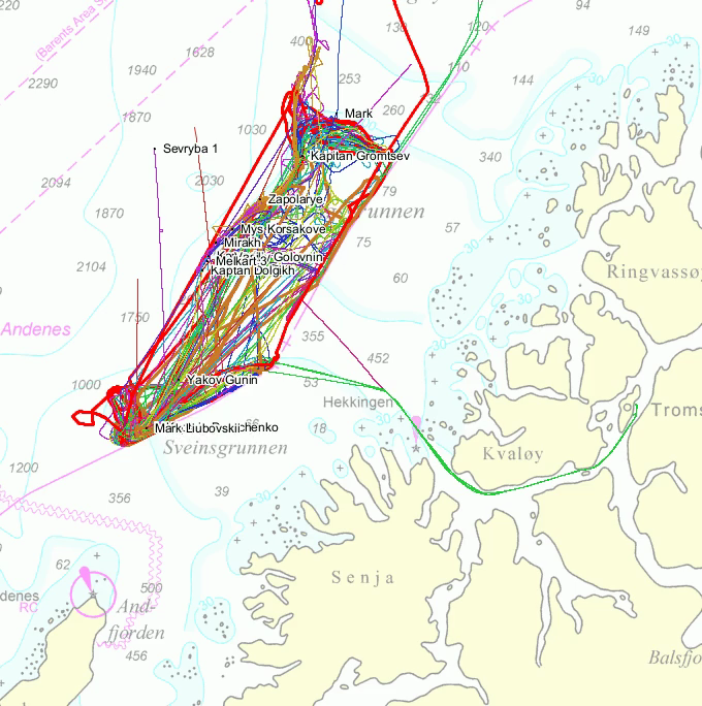
April 2016: NRK: “The red AIS tracks on the map show that the trawler “Taurus” sailed north of Andøya in April 2016. During the same period, a shooting exercise was reported in the area.”38
In the same area, the fishing banks of Sveinsgrunnen and Malangsgrunnen, there were also similar AIS tracks from more than 15 other trawlers. The North Atlantic cod spawns here in March and April. It looks like the fishing was good and that the “Taurus” was doing what the vessel was designed for, the trawler was fishing.39
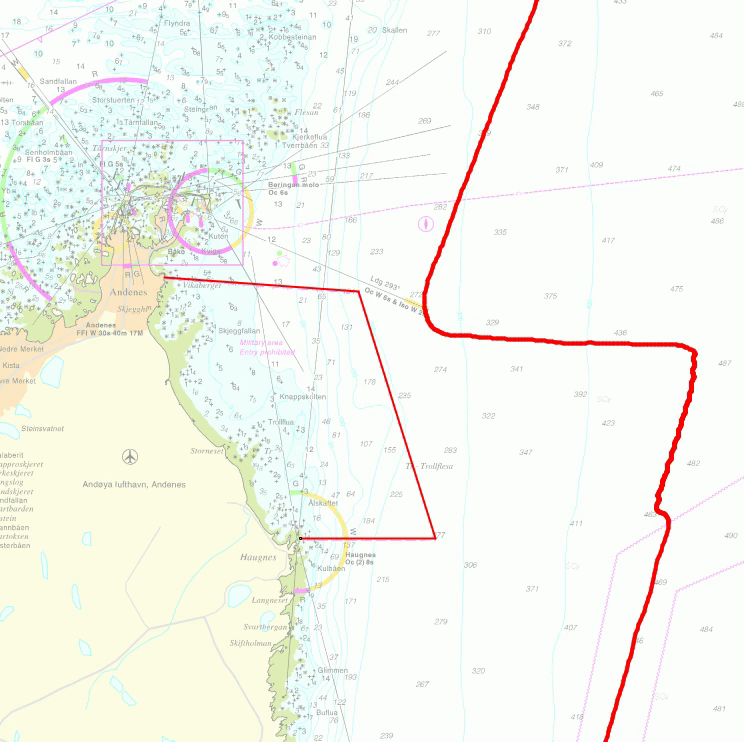
January 2016: NRK claimed that the “Taurus” could be conducting possible intelligence activity when the vessel headed west towards Andøya.40
The AIS tracks show that the Taurus was met by the rescue craft “RS Dagfinn Paust” outside the pilot station at Andenes.41 The Coastal Administration confirmed that a pilot disembarked the vessel.42
The “Taurus” facilitated disembarkation of a pilot off Andøya, it fished with 15 other trawlers north of Andøya, entered the floating dock for repairs at a shipyard near Ålesund, sought shelter from storms in Malangfjorden, was 9 hours too late to witness the crew change on an American nuclear submarine at Hekkinga, passed Tønsnes before an American nuclear submarine docked there in May 2021 and was not met by “KV Bison” in Tromsø harbor.
The nuclear submarines the “Taurus” sailed past arrived both times at Tønsnes while the vessel was docked in Tromsø. If this was not a coincidence, the trawler must have known the time of the submarines’ arrival in advance. It would have been interesting if NRK had shed some light on how this could have happened.
As you can see, the NRK journalists did not know what they were doing.
NRK: The radios on Ester and Lira
The trawlers “Ester” and “Lira” arrived in Kirkenes in early November 2022 and were inspected by the police. On board both vessels, the police found identical, old radios. The radios were not on the bridge, but were mounted inside the vessels in a locked room. The police took pictures of the radios and sent them to the Norwegian domestic intelligence service, PST. And a “secret source” in the police, conveniently informed NRK about the discovery.
The Finnmark Chief of the Norwegian domestic intelligence service (PST), Johan Roaldsnes, said that these were findings that reinforced the suspicion that espionage was being carried out from ordinary fishing vessels. He justified this by saying that the radios could send and receive military messages and that this provided military opportunities.43
The video below is an excerpt from the presentation by Kyst og Fjord at DataSKUP in 2024 and shows in detail how trivial it would have been for both PST and NRK to verify the information about the radios.
We uploaded the image of the radio into the Russian search engine Yandex. The search immediately showed that the radio was on display in several museums. On the “radioscanner.ru” page, the name of the radio was written; “Циклоида”, CYCLOID radio receiver.44 Both the Cycloid model and the almost identical Sibir model were made for the Soviet deep-sea fishing fleet.45 Production of the radio began in 1975 and it was still in production when Lira and Ester were built in 1989 and 1993, respectively.
The “Fishing Industry Fleet Reference Book” was published by the Soviet Ministry of Fisheries in 1990 and contain technical data for 119 vessel types. Among them is the Ester46 and Lira47 design, the “Atlantic 488”. A search in the book reveals that 21 of the vessel types were equipped with the “Cycloid” receiver and 32 of them with the “Sibir” model.48 That is close to half the Soviet fishing fleet.
According to a trawler skipper with experience working on Russian trawlers, calling home by satellite phone was previously too expensive for the crews, while calls using HF-radio were virtually free. The HF radio was therefore used extensively for this. According to Russian law, Russian crews are entitled to a separate room for private conversations.49 This explains why the radio was located in a separate compartment, and not on the bridge.
Only Russian coastal radio stations currently listen continuously to HF emergency channels. Other countries have shut down the service because it became unprofitable. This is a paradox. Norwegian and most other countries’ ships still only had HF radio as an approved emergency communication in the Arctic and Antarctic regions when the police found the radios on Lira and Ester.50 Iridium satellite communication was not approved until the summer of 2023.51 In the last few years until the approval, we were completely dependent on Russian coastal radio stations to receive emergency messages from high latitudes.
Interestingly, the Commission used the same radios to accuse the Melkart-5, owned by Murman Seafood, of espionage. According to Iceland Monitor, the Melkart-5 was berthed next to one of the trawlers, the Lira, in the Faroe Islands. The EU Commission considered this sufficient to include the radios in the “evidence list” against Murman Seafood too.52
Regardless of whether it is Norebo as the EU Commission claims, or Atlantrybflot JSC and Sea Star Co Ltd that own these vessels, the radios do not give reason to suspect espionage activities. The radios were not military, they were made for the fishing fleet.
Moreover, Norebo is not mentioned in any of the articles in connection with the radios on Ester and Lira, so it is not easy to understand how the EU Commission has arrived at the conclusion that Norebo owns them.
The PST has declined to respond to criticism or to comment on the matter. Prior to Kyst og Fjord’s presentation at DataSKUP in 2024, their justification for not responding was remarkable. The PST Chief wrote: “Even if one assumes that the PST has misinformed the public about a threat that turned out not to be real, the legal protection of Norwegian citizens has hardly been threatened as a result.”53
It is worth noting that the PST does not consider it problematic to warn against threats that do not exist.
After the presentation, the PST-chief changed her justification. PST now refuse to comment because they have classified the source information.54
The source was a retired British Warrant Officer who posed as an Intelligence Officer.55 NRK claimed that he listened to “highly secret” Russian naval communications and they allowed him to remain anonymous without giving any explanation other than that there were “understandable reasons” and that they had to protect his identity for “obvious reasons”.56
However, “James”, as the journalists called him, or John, as his real name is, said himself that he used the internet and open sources and listened to information about Russian vessels because he could not do what he had planned as a pensioner during the Covid lock-down. Open sources are not secret in any way and using them give no reason to be anonymous. There were others publishing the same information.57
This man was the sole source PST and NRK used to acquire information about the radios. Both PST and NRK trusted him without either of them disclosing any reason for their trust.58 However, NRK asked a pertinent question. Why would he be sharing his information with them and not with someone else? Strangely enough, NRK did not provide an answer.56
I also asked the source himself to comment, but he declined too.59
The espionage allegations from PST reported by NRK were based on information from a single source. An impostor, a Warrant Officer posing as an Intelligence Officer. NRK granted the impostor anonymity without giving any reason for doing so. Neither the PST nor NRK checked the information themselves. They did not verify it with other sources. Both organizations have been duly informed that the information they have reported is incorrect. Neither of them admits the error. None of them corrects it. Both organizations are funded from the Norwegian state budget.
The whole thing is just very, very embarrassing.
VRT NWS: The trawler Kapitan Sokolov
The allegations against the trawler Kapitan Sokolov were published by the Belgian public broadcaster “VRT NWS”60 in cooperation with Pointer, a part of the Dutch public broadcaster, KRO-NCRV.61 The case was also reported by EUToday.62
The articles were based on information from the Belgian Maritime Security Unit (Cel Maritieme Beveiliging), which is tasked with protecting ports and ships against illegal acts.63
They claimed that the “Kapitan Sokolov” had been spotted several times in the North Sea. The spokesperson for the organization, Thomas De Spiegelaere, said that the trawler had high-tech equipment on board that could be used both to find schools of fish and to spy with.64 They also indicated that the trawler could be involved in the incident in which the Chinese ship “NewNew Polar Bear” damaged the Balticconnector pipeline in the Gulf of Finland.
The Balticconnector incident
The Belgian Maritime Security Unit claimed that the AIS tracks from Kapitan Sokolov showed suspicious movements in the vicinity shortly before the damage to the pipeline occurred.
According to the AIS tracks, the trawler was sailing in Russian territorial waters in the eastern part of the Gulf of Finland, while the Balticconnector pipeline is located in the western part. It was 260 km as the crow flies between the trawler and the damage site at the time of the incident. The trawler was sheltering in the Beryozovye Strait, between the Beryozovye Islands and the mainland, when the pipeline was damaged.65
The video below show this clearly.
Kapitan Sokolov was built at Severnaya Verf in St. Petersburg. The vessel left the shipyard on 25 September 2023, barely two weeks earlier, to begin sea trials.66 A sea trial is a comprehensive testing period that a newly constructed vessel undergoes before being handed over to its owner. The trials are conducted in open water and is verification that the vessel performs as designed.67 It was the tracks from the sea trials that the Belgian Maritime Security Unit considered suspicious.
The AIS tracks gave little reason to believe in the Belgians’ suspicions. A Finnish investigation identified the NewNew Polar Bear as the culprit shortly after the incident.68 In August 2024, Chinese authorities had performed an investigation and concluded that the “NewNew Polar Bear” had accidentally damaged the pipeline.69
One month later, in September 2024, the case took a strange turn. The Belgian Maritime Security Unit now claimed that the AIS signals from the trawler, which they had previously considered suspicious, now also were false. However, they would not share any evidence backing this new claim.70
It is approximately 140 km from the western end of Russian territorial waters to the site where the Balticconnector pipeline was damaged, and yet another 140 km to the site where the fiber cable between Estonia and Sweden was damaged by the anchor from the “NewNew Polar Bear”.71 Judging from the reduction in speed of the container ship, it appears that the anchor was deployed approximately 90 km before the vessel crossed this fiber cable.72 A total distance of almost 400 km.73
Under the cover of the allegedly suspicious and now also false AIS signals, Kapitan Sokolov must have sailed to the area where the “NewNew Polar Bear” began to drop its anchor in order to have had an opportunity to assist in the deed. And it is hardly possible to provide such assistance without boarding the vessel. The weather was bad with 5 meters waves. Even if Kapitan Sokolov had maintained its maximum speed of 15 knots, the round trip would have taken more than 24 hours.74 Just carrying out the voyage would have been risky before the sea trials were completed - and they had barely begun.
The Belgian Maritime Security Unit suspects that this may have happened. They have not said anything about why they believe the Russians may have created fake, but still suspicious AIS tracks. This appears utterly stupid if it is true. Neither have they explained how they believe the alleged assistance contributing to the “NewNew Polar Bear” dropping its anchor actually took place. It is hardly possible to drop the anchor without being on board the vessel. However, they will not provide any evidence.
Earlier this year, the captain of the “NewNew Polar Bear” was detained in Hong Kong for damaging the Balticconnector pipeline.75
Observations in the North Sea
The sea trials of the “Kapitan Sokolov” lasted until December 2023. Then the trawler returned to the shipyard and remained there for more than a year. The AIS tracks from Global Fishing Watch (GFW) show that the trawler did not leave Russian territorial waters until April 10, 2025. It then sailed into the North Sea from the Skagerak in the Norwegian economic zone on April 15.76 The trawler continued north along the Norwegian coast directly to Kirkenes and continued on to Murmansk and has operated in Russian waters since then.
The sea route from the Gulf of Finland to the North Sea passes through Danish waters. A review of all AIS data from the Danish Maritime Authority from September 2023 when the “Kapitan Sokolov” was launched reveal no tracks in Danish waters from the vessel until April 13, 2025.77
No one else has reported seeing the vessel in the North Sea during this period. Yet, the Belgian Maritime Security Unit claims that the vessel has been observed several times in the North Sea a year earlier. They have not provided any evidence for this claim neither.
When Thomas De Spiegelaere made the claim in May 2024, Kapitan Sokolov had not sailed outside Russian territorial waters in the Gulf of Finland. With the exception of the transit to Murmansk in April 2025, the vessel has only sailed in Russian waters to date, according to the AIS data from GFW.
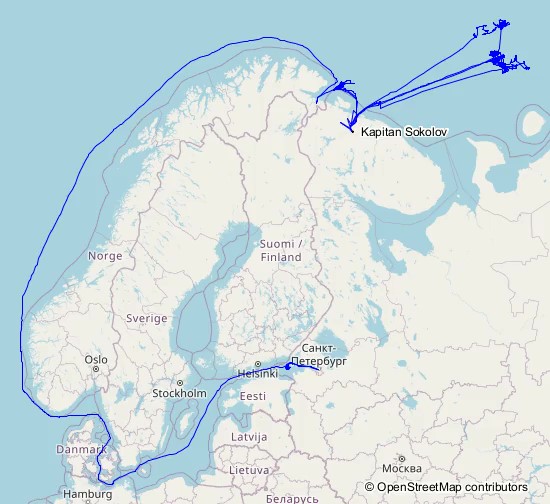
Kapitan Sokolov sailed from the Gulf of Finland to Murmansk via Kirkenes in April 2025. The vessel has not sailed outside Russian waters before or since. It is incredible that the Belgian maritime security unit was able to observe the vessel in the North Sea a year before it ever sailed there. AIS-data from Global Fishing Watch.
High-tech equipment
The spokesperson for the Belgian Maritime Security Unit also stated that Kapitan Sokolov had high-tech fish-tracking equipment on board that gave rise to suspicions of espionage. He said that the equipment could be used for other detection tasks than just finding schools of fish.78
The vessel is equipped with normal fish-finding equipment,79 a SX90 sonar from Simrad80 and multi-beam echo sounders from Furuno.81
The most advanced equipment, the sonar, has a range of 5,000 meters. This range can be increased to 10,000 meters, but that requires an export license. The reason for this is that US authorities consider the extended range to be a threat to national security, perhaps because it may be possible to locate submarines.82 There is no information available to suggest that the equipment has been sold in violation of the export regulations.
In their product catalog, Simrad describes the SX90 as a workhorse. The illustration in the catalog is “F.V. Shuktara”, an older trawler from Bangladesh with the sonar installed.83 On the Facebook page of the Simrad dealer in Bangladesh, there are pictures of around 40 trawlers that since 2021 have been retrofitted with the same SX sonar as the one the Kapitan Sokolov is equipped with.84 Simrad has two sonar models with better performance for fishing vessels in their portfolio, the SU90 and the ST90. Several of the vessels in Bangladesh have installed the improved SU model.
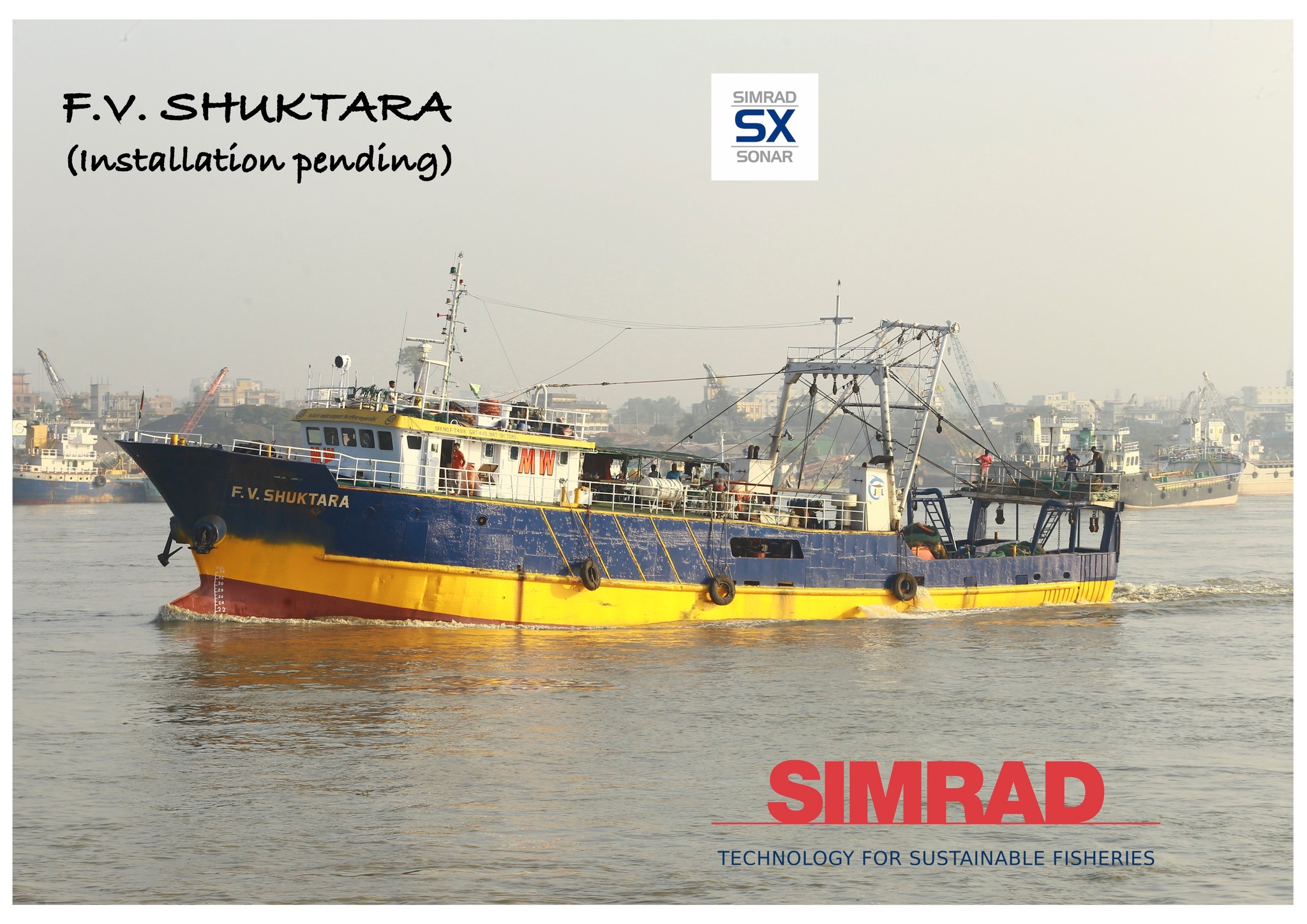
Simrad is using this vessel when advertising for the SX90 sonar, the same sonar as the Kapitan Sokolov is equipped with. With such a basis, the Belgian maritime security unit can accuse any fishing boat of espionage. In Bangladesh, the fishing fleet has started upgrading to the more modern SU90 model.
Cel Maritieme Beveiliging has not responded to a request for comment.
The Russian Maritime Doctrine
“VRT NWS” and Pointer used the Russian maritime doctrine as justification for claiming that Russian vessels related to fishing in general, and the Kapitan Sokolov in particular had become a threat.
The articles stated that “points 84 and 85 of part 7 of the doctrine summarize this well.” And further; “civilian ships are adapted in advance, and the crews are trained to serve in wartime. And in peacetime, all fishing vessels, transport ships, and specialized ships may be used by the armed forces of the Russian Federation.” “In short: even Russian fishing boats can be at the Kremlin’s disposal at any time.”
Paragraph 84 in the doctrine states the importance and the goal of being able to incorporate and train civilian crews in advance of wartime operation. Paragraph 85 details the prioritization of maritime mobilization training and sub-paragraph 9) is the point that is the basis for the allegations of espionage activities from civilian vessels:
“85. The priority areas for improving mobilization training and mobilization readiness in the field of maritime activity are: … 9) improving the procedure for the conscription and use of transport, fishing and specialized vessels of all forms of ownership, as well as the use of port facilities by the Armed Forces of the Russian Federation, other troops, and military units conducting special operations in peacetime;”85
The conscription, summons or requisition procedures are to be improved for the Armed Forces and other troops in preparation for wartime, and correspondingly, for military units conducting special operations in peacetime.86
The term used in the doctrine, “специальных операции” – “special operations”, is explained in Encyclopedia Britannica: “Special operations warfare is conducted by uniformed military forces. This distinction helps to differentiate special operations warfare from activities such as sabotage and subversion conducted by intelligence agencies or internal security and policing conducted by police units”.87 Examples include the German GSG-9, the British “Special Air Service” (SAS) and the Russian Spetsnaz.
“VRT NWS” and Pointer argue that the term “in peacetime” also refer to the use of civilian vessels and port facilities by the Armed Forces, not only in wartime but also in peacetime. However, this is a misinterpretation because it makes the explicit mention of “military units conducting special operations in peacetime” redundant, as the special operations forces are part of either the Armed Forces or the “other forces” already mentioned.
The reason for including the use of civilian vessels in peacetime in the maritime doctrine is apparently also easy to identify. On the website of the Russian Ministry of Defense, the main purpose of the Russian Armed Forces is stated as (machine translated): “in peacetime - peacekeeping missions and special operations of troops (forces) in internal armed conflicts;”88
Perhaps not so surprising then that support for military units conducting special operations in peacetime appeared in the maritime doctrine. This information was posted on the Defense Ministry website in 2015 and remained unchanged in 2022. The possible use of special operations forces in internal armed conflicts in Russia does not give reason to neither suspect nor warn of possible espionage from fishing vessels in the North Sea.
The aforementioned points in the doctrine are very similar to the Norwegian “requisition act”.89 It states that when the country is at war, or if the government in peacetime deems it necessary to be prepared, the Armed Forces can requisition anything they need, including vessels, with or without crew. The government can also demand that civilian enterprises in peacetime prepare themselves by mounting cannons on vessels and make other appropriate preparations.90
The claim that the doctrine facilitates the use of civilian vessels for gray zone and espionage activities in peacetime is not correct. An observed or perceived increase in such activity cannot be inferred from what is written there.
VRT NWS has not responded to a request to disclose the source of the interpretation of the doctrine they reported.
The Barents Observer: The reefer Belomorye
The reefer (refrigerator ship) Belomorye experienced problems with its rudder when it was approximately 110 nautical miles west of Kristiansund on the Norwegian west coast on the night of November 24, 2024. The vessel drifted around without steering and declared an emergency.
Later that morning, the Chinese vessel “Ocean 28” was heading south further south along the Norwegian coast. Just past the weather-wise notorious Stad area, the ship turned around and sailed northeast before it started sailing back and forth outside Norwegian territorial waters in the area west of Molde and the LNG terminal in Nyhavna. At midday on 26 November, the vessel continued its voyage south.
“Ocean 28” was sanctioned by the United States because it had been transporting modules to the Russian Arctic LNG 2 project on the Gydan Peninsula in Siberia.91 There are no reports claiming that the vessel is suspected of espionage activities.
The next morning, on 27 November, the salvage vessel “BB Coaster” reached the Belomorye. “BB Coaster” towed the vessel in distress to Freifjorden. The tow arrived at the anchorage “Freifjorden 1” in the evening the same day.
The tracks from the Chinese and Russian vessels are closest to each other in the area just outside Norwegian territorial waters. When the tow with the Belomorye approached the territorial waters north of the area where the Chinese vessel had previously lingered, the Chinese vessel was long gone. At this time the “Ocean 28” was northwest of Haugesund. It was 230 nautical miles or 430 km between the vessels.
It is very hard to see anything that could be suspicious about the casualty, Belomorye, being towed by a Norwegian tug, north of an area that a Chinese vessel had left more than 24 hours earlier, as reported by “The Barents Observer”. The Norwegian authorities decided where the vessel would be towed and the vessel was not in control of when it would happen. Any connection between the tracks of the Chinese vessel “Ocean 28” and Belomorye lacks support in the sequence of events exposed by the AIS-data.
The Norwegian Armed Forces Operational Headquarters (FOH) provided the following information on the matter upon request:92
“BELOMORYE declared an emergency after experiencing problems with the rudder. She was unable to sail under her own power and was towed into Norwegian internal waters pending further clarification. The Russian tug VENGERY was later given permission by Norwegian authorities to enter Norwegian internal waters to tow BELOMORYE to a Russian port for repairs. FOH considers the purpose of entering Norwegian internal waters to be legitimate for both vessels.”
There is also a simple and very plausible explanation for why the Ocen 28 turned around just south of Stad, sailed northeast, and waited for two days just outside the Norwegian territorial waters.
The AIS tracks show that the vessel was to continue through the English Channel and south around the Horn of Africa.
According to the UK Met Office, there was bad weather in the North Sea and the English Channel. Storm Bert was followed by storm Conall. Conall passed through the English Channel during the night between 26 and 27 November. Storm Bert lasted from 22 to 25 November and resulted in the wettest calendar day recorded in the UK since 1920.93 A gale warning was issued for the North Sea, the English Channel and the Bay of Biscay during this period. For 25 November, for example, the warning was rough seas and near gale to severe gale from the east and south-east, veering towards the south in the North Sea.94
Ocean 28 was sheltering off the coast of north-western Norway, thereby avoiding sailing through the English Channel while Storm Conall passed through the area. There is little reason to suspect anything but excellent seamanship.
Pointer: Arctic Princess - espionage in Eemshaven?
The Belomorye had to turn back earlier that year while en route to Eemshaven in the Netherlands with fish because Dutch authorities no longer granted the vessel an exemption from the sanctions. According to the Dutch Pointer, this was because the vessel could be involved in espionage.95
Until this point in May 2024, Russian reefers transporting fish to the Netherlands had been granted exemptions from the sanctions upon request. Food products are not sanctioned and Russian vessels transporting fish were allowed to dock in the Dutch harbours.
In May 2024, the Dutch Minister of Infrastructure and Water Management wrote a letter to the President of the Parliament in response to questions directed to the Minister of Defense from the representative Kahraman.96 Kahraman referred to a Pointer article from 4 May.97 The article pointed out that the Russian reefer, “Arctic Princess”, also owned by Norebo, had been berthed in Eemshaven and unloaded fish at the same time as the container ship New Amsterdam was unloading military equipment. The equipment had been used by the Dutch armed forces during the NATO exercise Nordic Response in Finnmark in northern Norway.98
Kahraman asked if the Minister of Defense could confirm whether there had been any espionage incidents in Dutch waters involving Russian fishing vessels. He also asked what the Minister of Defense would do about these vessels having access to Dutch ports.99
In her response to Kahraman, the Minister of Defense, Kajsa Ollongren, said that unlike the port of Den Helder, Eemshaven was not military, although the port was occasionally used for military purposes. When that happened, it was assessed whether special measures were necessary because military activity and transport were not always secret. In particular, she mentioned that when transferring material for exercises, it was a point in itself that the activity was visible. And, they were fully aware of the possibility of espionage activities, the defense intelligence service, the MIVD, had warned about this for a long time.96
The Minister of Infrastructure and Water Management stated in his letter that a request for an exemption from the sanctions by a Russian vessel to unload fish would not be granted.100 The reason for this was increasing geopolitical tension and announced tightening of European sanctions, he wrote.101 Espionage was not mentioned as a reason for not granting an exemption in the letter.
The AIS tracks of the Belomorye shows that the vessel arrived west of IJmuiden in the Netherlands on the morning of 16 May and began its return voyage the same evening, without having been in port.
The Organization for Security and Co-operation in Europe, OSCE, consists of 57 states, including the Netherlands, Norway and Russia.102 According to the organization’s regulations on confidence- and security-building measures, exercises involving more than 9,000 soldiers must be notified at least 6 weeks before the exercise begins. The notification must include, among other things, the total number of tanks, the number of armored vehicles and the number of artillery units and rocket launchers from each participating country.103
The Nordic Response exercise, from which the ship New Amsterdam unloaded military equipment when Pointer believed that the Arctic Princess might have been spying, involved 11,000 soldiers. The exercise had been notified through the OSCE, so the Russians were already informed of what equipment the Dutch had used.
There is no basis for suspecting espionage against a transport where the cargo manifest had already been given to the suspect, and which the Dutch defense authorities wanted transparency about, according to the Minister of Defense. The Dutch authorities did not justify the refusal to grant Belomorye an exemption from the sanctions for delivering fish with fears of espionage, that was something Pointer wrote based on their own assumptions.
Also, it would be rather reckless if the Dutch military carried out covert operations in plain sight in a civilian port without taking precautions, regardless of whether Russian vessels were present in the port at the time or not.
Follow The Money: The reefer Canopus
The investigative magazine “Follow The Money” (FTM) published an article in June last year with the title “Almost 200 Russian ships suspected of spying in the North Sea”.104 The article showed AIS tracks from two Norebo vessels, the reefers Canopus and Sirius.
In the article, FTM included a video with AIS tracks from the Canopus where they wrote that: “The Canopus shows suspicious behavior. The vessel lay for several days near Vlieland, above two pipelines. Then the signal is lost and the ship shows up 71 kilometers north of Terschelling.” At the end of the video they wrote that “The AIS data turns out to be wrong, according to port authorities. It is a false alarm”.
AIS data acquired from “Astra Paging” shows more of the Canopus’s voyage than the FTM article did.105
The tracks showed signs of being incorrect from around 07:00 (UTC) on the morning of July 12, 2018. It looked like the vessel lay still for just over 8 hours, before at approximately 15:15 it sailed east for 2 hours to a location just inside the territorial waters of the Netherlands where the vessel lay still for five days before the track jumped to the quay in Velsen. Velsen is located on the North Sea Canal, approximately 7 kilometres inland, east of the coastal town of IJmuiden.
At the same time as the tracks started to look strange at 07:00 and showed the vessel at rest, the estimated time of arrival (ETA) included in the AIS data was adjusted from 12:00 on July 12 to the invalid time of 24:60. When the arrival time was adjusted again to a valid time at 15:15, the position data started updating again, but with a systematic error: The tracks continued from the location where the vessel was located when the error occurred.106
By moving the AIS tracks from the time after they started moving again when the invalid ETA was adjusted to a valid time, and until they jumped to the dock in Velsen, by the distance between the position reported just before the jump and the position at the dock immediately afterwards, it turns out that the vessel had continued its voyage at an average speed slightly less than 9 knots, and was approaching IJmuiden when the tracks showed movement again at 15:15.107 The tracks show that the Canopus sailed into IJmuiden, through the “Zuiderbuitenkanaal” and into the “Middensluis” at 17:00 and docked on the north side of the lock. A quarter of an hour later it continued through the Noordzeekanaal and docked in the “Zijkanaal A” in Velsen-Noord at 20:00 local time on 12 July, just north of the intersection of the streets Velserkade and Platformweg.
The pipeline that FTM thought Canopus was laying still over was in reality the quay in Velsen.
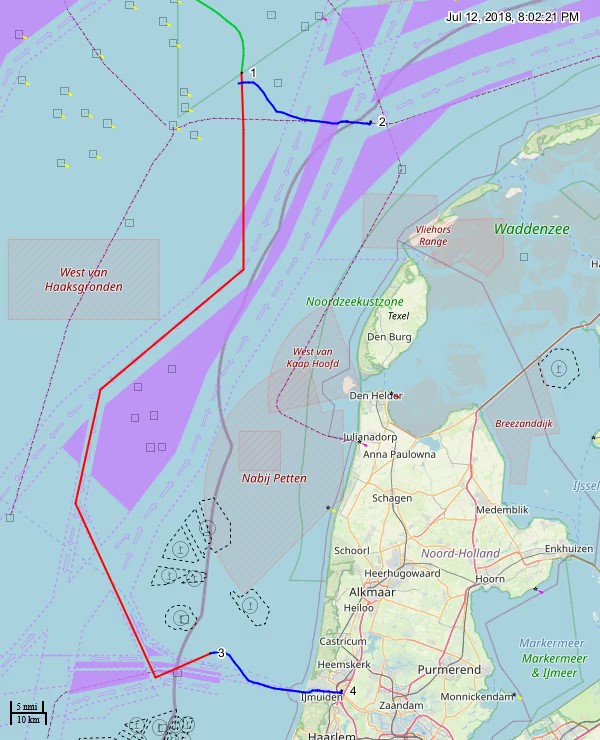
Canopus arrived in Velsen at 20:00 local time on 12 July 2018. The vessel was not laying over pipelines off Vlieland for 5 days, it was berthed in Velsen. The red line is an estimated route that the vessel is likely to have followed along the shipping corridor to IJmuiden. AIS data for this time period is incorrect and shows the vessel at rest near (1). The bottom blue line (3, 4) has the same shape as the top line (1, 2). The displacement is identical to the distance before and after the position jump in the data on 17 July. See details from the dataset in the references.
In the morning two days later, the vessel moved to a berth about 300 meters further south along the canal.
The tracks then show that the vessel left the quay in Velsen on the morning of July 18 and sailed back through the Noordzeekanaal. At 13:20 it entered the “Middensluis” where it lay on the south side of the lock for around 20 minutes before sailing further out through the Norderbuitenkanaal, out into the North Sea and then north along the Norwegian coast to Tromsø.
The difference between the dataset FTM used and the data provided by Astra Paging is interesting. FTM stated that they used data from Global Fishing Watch (GFW).108 I contacted GFW to ask if there was reason to suspect a vessel of wrongdoing simply because data was missing from their database. They replied that they collected data from various sources which was not exhaustive, and that even if the vessel was included in the sources, their filtering could cause vessels they had in their internal database not to be part of the publicly available product.109
If you look for AIS tracks from the Canopus from the GFW today, all the data from July 11 to July 18, 2018 is missing. Both the erroneous data during the approach that FTM considered suspicious, and the data from the port stay and the voyage out of Velsen have been filtered out.
Hidden away on a Github page, FTM describes the method they used to identify suspicious vessels. In short, they created a list of Russian vessels that had already been mentioned by other media outlets in connection with gray zone activity and sanctions. They combined this with some simple technical criteria such as deviations from normal routes, AIS signals disappearing, etc. They then collected information about the location of infrastructure and measured the distance to vessels that were nearby.110
They also comment that it is very difficult to determine whether AIS data is missing due to errors, or whether they have been turned off intentionally, and that the data they used had quality problems that led to false alarms.
Finding it difficult to determine whether what they found was truly suspicious, they manually inspected some of the findings and discussed them with experts. According to FTM, this did not imply that the vessel was guilty of anything, only that it was exhibiting behavior that was worth investigating further. However, strangely enough, they did not examine any of the findings they made in detail themselves.
Based on the criteria the journalists themselves constructed, they made the headline “Almost 200 Russian ships suspected of spying in the North Sea”. But, that was not what they had found. What they found was “almost 200 tracks from Russian ships for which the journalists had no immediate explanation”.
Others using the same method can use the list from FTM when looking for Russian vessels mentioned in the media. A method where unconfirmed and erroneous suspicions can be used again and again. A vessel that has once been mentioned cannot get rid of the allegation because the method does not include a search for information that can refute the suspicion.
But, as you can see here, such information is not difficult to find.
Financial Times: Sabotage in the Baltic Sea
In October 2023, the Chinese container ship “NewNew Polar Bear” dragged its anchor on the bottom of the Baltic Sea into the Gulf of Finland.111 The anchor damaged a gas pipeline and three fiber cables, one of them was Russian.112 In November, just over a year later, the Chinese bulk carrier “Yi Peng 3” did the same thing and the anchor damaged two fiber cables.113
One month later, the anchor of the oil tanker “Eagle S” damaged four fiber cables and one power cable between Finland and Estonia,114 and at least one Russian fiber cable, possibly two, between St. Petersburg and Kaliningrad.115 And one month after that, the bulk carrier Vezhen dragged its anchor on the bottom and damaged yet another cable.116
The EU Commission has included an article from the Financial Times (FT), “Inside Russia’s Shadow War in the Baltic Sea”, in its “evidence package”. The article is focused on the possibility that the events in the Baltic Sea could be Russian sabotage.117 The article shows images of the Finns boarding the “Eagle S” from a helicopter and Finland’s Foreign Minister is quoted saying that the incident “is part of the aggression and threat that Russia poses to our way of life.” The word sabotage is used 26 times in the article.
The article states that the incidents took place over a period of 17 months. It was published in early March, 17 months after the first incident and more than a month after the fourth incident involving the bulk carrier Vezhen. However, only three vessels were mentioned, the incident with Vezhen was omitted.118
A bit more than a week after Swedish authorities seized the Vezhen, the vessel was released and the sabotage charges were dropped. State Prosecutor Mats Ljungquist told Expressen that they had a film showing the incident. It shows that there is no one nearby when the anchor is dropped.119
The investigation found that there were three different locking devices connected to the anchor. Two were out of order and the last one broke. It is not possible to open the anchor lock from the bridge by pressing a button, it can only be opened manually. The film showed a huge wave hitting the vessel and a shower of sparks as the lock broke and the anchor sank to the bottom. The crew did not notice that the anchor was released, the vessel went on autopilot and compensated the speed. No alarm was triggered.
The case brought by the Finnish prosecutors against three of the crew of the “Eagle S” was dismissed by the Helsinki District Court. The Finnish authorities lacked jurisdiction, the case should be handled by the flag state, the Cook Islands, under the United Nations Convention on the Law of the Sea (UNCLOS).120 Neither the district court nor the prosecutors found evidence indicating that the anchor had been intentionally dropped to damage the cables.121 The district court also noted that the case did not meet the legal requirements for sabotage or aggravated sabotage because there was no interruption in neither power supply nor communications. The prosecutor has appealed the decision to dismiss the case.122
The Swedish Accident Investigation Board participated in the Chinese investigation of the “Yi Peng 3”, but found no evidence that the anchor had been intentionally released.123 The Chinese investigation is still ongoing.
The result of an internal investigation by the Chinese authorities was that the “NewNew Polar Bear” released its anchor and damaged the Balticconnector pipeline due to an accident caused by bad weather.124 However, the Estonian prosecution does not recognize the investigation report as evidence.125 In May 2025, the captain of the “NewNew Polar Bear” was detained in Hong Kong.126 He is charged with damaging the pipeline and subsequently sailing without an anchor. Finnish authorities continue to cooperate with the Chinese authorities in the investigation.127
Vessels dragging anchors without being aware of it is nothing new.
In 2002, the container ship Aconcagua severed three of the four cables that then connected the United States to Europe on a voyage from Philadelphia to New York. The captain mistakenly believed that the reduction in speed from the anchor the vessel was dragging was due to strong head wind.128 In 2008, an oil tanker dragged its anchor for 300 kilometers and damaged six cables off Sicily. A report from British Telecom shows that vessels dragging their anchors without realizing it had damaged 13 cables from 2007 to 2010 in the waters around the United Kingdom alone.129 That’s more than three cable breaks a year.
In the “best practice” guide for governments, the International Cable Protection Committee (ICPC) state that statistics indicate that approximately 70 percent of the damage to submarine cables is caused by fishing activities and anchor damage. The first item on the list of anchor-related damage is “improperly-stowed anchors, which release or fall overboard and can be dragged for great lengths along the sea floor, damaging cables along the anchor’s path”130
Back to the Financial Times article, why didn’t they mention Vezhen?
A likely explanation is simply that the film showing that the incident was an accident did not fit the story they wanted to tell about possible Russian sabotage.131 This is one of the prerogatives of the media, they can choose what they want to present to support their view. The editorial staff is not obligated to be objective.
The EU Commission justified the use of press articles as the basis for the accusations against Norebo by saying that they lacked investigative authority. Both Sweden and Finland are EU member states that conducted investigations in connection with the cable breaks in the Baltic Sea.
The Commission used an article from a US paper as evidence and apparently ignored the Member States’ investigations. This gives reason to suspect that the Commission only was looking for material supporting its conclusion, that Russia is conducting a sabotage campaign in the Baltic Sea, and ignored evidence refuting it. It is also worth noting that no Norebo vessel is mentioned in connection with the investigations.
Such selective use of sources is not compatible with the Norwegian sanctions regulations. These regulations aim to prevent arbitrariness, not encouraging it, as the EU Commission’s course of action necessarily does when measuring out punishment based on unverified media articles.
What is next?
The EU Commission justified the sanctions by saying that vessels operated by Norebo had shown movement patterns that were inconsistent with regular economic practices and fishing activities. The vessels were allegedly repeatedly in proximity of critical infrastructure and military installations. The movement patterns had been linked to a Russian state-sponsored surveillance campaign by both Member States and authorities in third states.
The campaign allegedly used trawlers to conduct espionage missions directed against civilian and military infrastructure. This, according to the regulation, facilitated future sabotage operations in both the North Sea and the Baltic Sea. Ships owned by Norebo had also been equipped with technology that could be used for espionage and a Norebo vessel had been denied entry to Dutch ports due to espionage. Norebo had received several loans from a Russian state-owned bank and the EU believed that the Russian maritime doctrine allowed the Russian armed forces to use civilian ships in peacetime.132
According to the regulation, this showed that Norebo supported Russian state activity that undermined the security of the EU, several member states and third countries, by engaging in activities aimed at disrupting critical infrastructure.
The primary sources for the espionage allegations against the Norebo are the public broadcasters in Norway (NRK), Belgium (VRT NWS) and the Netherlands (KRO-NCRV/Pointer), as well as the investigative Dutch magazine “Follow The Money” and the Norwegian news outlet, “The Barents Observer”. The other articles about espionage activities from the Norebo vessels are reproducing the material from these sources.
NRK’s allegations against the trawler Taurus were based on the journalists’ own work. The allegations NRK conveyed about military radios aboard the trawlers Ester and Lira came from the Norwegian intelligence service. If the EU Commission had bothered looking for material that refuted NRK’s findings, they would have found it.133
KRO-NCRV/Pointer, the Dutch public broadcaster, suspected that the Russian reefer Arctic Princess was spying on the unloading of military equipment based on the journalists’ own work. The Belgian Maritime Security Unit was the source of “VRT NWS” and KRO-NCRV/Pointer’s espionage allegations against Kapitan Sokolov. Dutch “Follow The Money” was itself the source of the suspicions against the Canopus.
The third country the Commission mentions where the EU lacks investigative authority is Norway. The rest of the information about the suspected espionage activity comes from sources in the EU member countries Belgium and the Netherlands. There is no lack of EU investigative authority in those countries.134
However, the EU Commission nevertheless chose to let the press be the judge.
It was the Norwegian public broadcaster, NRK, that was first out and showed the way with the speculative journalism based on suspicions and confirmation bias on steroids. NRK singled out the Norebo trawler Taurus and manipulated the presentation in the Shadow War to make things look suspicious. The allegations from NRK are the main basis for the sanctioning of both Norebo and Murman Seafood. It appears like the NRK coverage paved the way and encouraged and emboldened the other editorial teams.
The espionage allegations from NRK, Pointer, “VRT NWS”, “Follow the Money” and “The Barents Observer” are both erroneous and unfounded. The allegations should have been investigated in a responsible manner before they were used for punitive measures.
The only item on the commission’s list that has not yet been discussed here is the loan in Sberbank. The reason for that is simple. A loan is not sabotage or surveillance, it is not a threat to critical infrastructure and therefore it cannot undermine security.
It is unlikely that the newspaper articles will hold up as evidence if Norebo takes legal action against Norway to be removed from the sanctions list. It will be very interesting if Norebo follows Murman Seafood’s example and complain to the Ministry of Foreign Affairs in accordance with paragraph 6 of the Sanctions Act, and at the same time prepares for legal action.135
It is also hard to see how a small country like Norway will benefit from replacing law and order with arbitrary justice measured out by editors and journalists. The Norwegian government is therefore dangerously close to conducting self-harm when it follows the EU Commission and supports the arbitrary regulatory governance that is the basis for the sanctions. This is arbitrariness as a system, a real, systemic threat to democracy that also jeopardizes the fisheries cooperation with Russia for no reason whatsoever.
The NRK series The Shadow War has become Norwegian foreign policy. It is both very embarrassing and a very dangerous development.
References
-
LM-001/2025 : Uppskot til løgtingslóg um broyting í løgtingslóg um avmarkandi tiltøk í sambandi við atgerðir móti Ukraina (Víðkaðar heimildir at seta onnur avmarkandi tiltøk í verk í sambandi við hybridhóttanir o.a.): https://www.logting.fo/mal/mal/?id=11218 ↩︎
-
Re: Parliamentary Bill to Amend the Statute on Restrictive Measures in Connection with Actions Against Ukraine (the ‘Draft Bill’), Case No: 25/20885: https://www.logting.fo/documents/68021 ↩︎
-
Prop. 69 L (2020 – 2021): https://www.regjeringen.no/contentassets/5ffb8a475151484083827ae96f07c2ee/no/pdfs/prp202020210069000dddpdfs.pdf ↩︎
-
Lov om gjennomføring av internasjonale sanksjoner (sanksjonsloven), § 6 e. og § 7: https://lovdata.no/dokument/NL/lov/2021-04-16-18 ↩︎
-
Regarding the 17th sanctions package - Murman Seafood Co. Ltd. - Letter to the Minister of Foreign Affairs of Norway, 14.11.2025: Part 1: https://einnsyn.no/saksmappe?id=http%3A%2F%2Fsaksmappe.972417920.no%2F3ef70f85-5228-43c4-a434-470cc0aa82ec&jid=http%3A%2F%2Fjournalpost.972417920.no%2Fc8d32b87-3c1c-46ec-af09-fd7efaf4856e, Part 2: https://einnsyn.no/saksmappe?id=http%3A%2F%2Fsaksmappe.972417920.no%2F3ef70f85-5228-43c4-a434-470cc0aa82ec&jid=http%3A%2F%2Fjournalpost.972417920.no%2F245a88cd-7d7b-468e-b5ee-48f2e05259ad ↩︎
-
Vinneren er kåret: Les metoderapportene til Data-SKUP-prisen, Vedlegg: Kyst og Fjord: «Skyggekrigen: Kan vi stole på NRK?»: https://www.skup.no/2024/10/vinneren-er-karet-les-metoderapportene-til-data-skup-prisen ↩︎
-
Kan vi stole på NRK? 27 oktober 2024: http://skyggekrigen.no/artikler/dataskup-presentasjon/ ↩︎
-
Klage til Kringkastingsrådet: Feilinformasjon, mangelfull presisering og retting av feil, Dato: 18.05.2025: https://skyggekrigen.no/files/NRK-mangelfull-presisering.pdf ↩︎ ↩︎ ↩︎
-
Russland gjentar trussel om å bryte fiskeriavtalen med Norge, Publisert 2. nov. 2024: https://www.nrk.no/tromsogfinnmark/russland-gjentar-trussel-om-a-bryte-fiskeriavtalen-med-norge-1.17107271 ↩︎
-
fairway certificate: norwegian: farledsbevis: Grants the navigator permission to sail without a pilot in specific waters. ↩︎
-
NRK om kritikken: – Vi kommer ikke med påstander vi ikke har belegg for, Publisert: ons 07.06.2023: https://www.highnorthnews.com/nb/nrk-om-kritikken-vi-kommer-ikke-med-pastander-vi-ikke-har-belegg ↩︎
-
Hevder NRK har manipulert deler av storavsløring: – Nører opp til russofobi, Publisert 31.10.2024: https://www.m24.no/data-skup-havard-gulldahl-kyst-og-fjord/hevder-nrk-har-manipulert-deler-av-storavsloring-norer-opp-til-russofobi/765169, arkivert: https://skyggekrigen.no/files/M24-Hevder-NRK-har-manipulert-deler-av-storavsloring.pdf ↩︎
-
Kan vi stole på NRK? 27.10.2024: https://skyggekrigen.no/artikler/dataskup-presentasjon/ ↩︎
-
Svar på innsynsbegjæring - KV - Hva en utenlandsk tråler (Taurus) har meldt som begrunnelse for å benytte territorialfarvannet, 2023-08-17: https://skyggekrigen.no//files/Svar-på-innsynsbegaering-Kystvakta-KV-Bison.pdf ↩︎
-
Forskrift om fremmede fartøyers anløp til og ferdsel i norsk territorialfarvann (anløpsforskriften): https://lovdata.no/dokument/SF/forskrift/2024-11-01-2627 ↩︎
-
Contact information to Lødingen pilot station: pilot.lodingen@kystverket.no ↩︎
-
Taurus is 64 meters long: Forskrift om losplikt og bruk av farledsbevis (lospliktforskriften): https://lovdata.no/forskrift/2014-12-17-1808/§3 ↩︎
-
“The spy ships”: NRK’s investigative journalists publishing flawed evidence of Russian espionage, 16 June 2024: https://skyggekrigen.no/en/artikler/under-sporene/ ↩︎
-
Kan vi stole på NRK? 27 oktober 2024: https://skyggekrigen.no/artikler/dataskup-presentasjon/ ↩︎
-
Brennpunkt: Skyggekrigen 1. Putins spioner i Norden: https://tv.nrk.no/serie/brennpunkt-skyggekrigen/sesong/1/episode/MDDP11240122 ↩︎
-
Die Spionageschiffe, 19. april 2023: https://www-nrk-no.translate.goog/nordland/xl/fiskebater-og-andre-fartoy-fra-russland-kan-drive-spionasje-og-etterretning-i-norge-1.16371100?_x_tr_sl=no&_x_tr_tl=de&_x_tr_hl=de&_x_tr_pto=sc ↩︎
-
Tensions rise in Denmark over Russian boats in Faroese waters, April 24, 2023: https://www.courthousenews.com/tensions-rise-in-denmark-over-russian-boats-in-faroese-waters/ ↩︎
-
Trawler owned by Russian fishing giant accused of tracking US nuclear submarine as part of covert surveillance operation, Published 20 April 2023: https://www.intrafish.com/fisheries/trawler-owned-by-russian-fishing-giant-accused-of-tracking-us-nuclear-submarine-as-part-of-covert-surveillance-operation/2-1-1437074 ↩︎
-
Lov om straff (straffeloven), § 225 b.: https://lovdata.no/lov/2005-05-20-28/§225 ↩︎
-
Taurus: Mai 2021
↩︎NRK's version: In early May 2021, an American nuclear submarine arrives in Tromsø. At the same time, the trawler "Taurus" is passing by. First on its trip south, then when it returns north the next day.
"Taurus" sailed past Tønsnes on its way to Tromsø before the American nuclear submarine arrived there. The speed past Tønsnes was just over 12 knots both on the way south to Tromsø and on the way north the next day.
-
Amerikansk ubåt møtt av demonstranter i Grøtsund, Publisert 10.05.2021: https://www.forsvaretsforum.no/atomsikkerhet-heimevernet-haeren/amerikansk-ubat-mott-av-demonstranter-i-grotsund/199174 ↩︎
-
TROMSØ, Norway - Virginia-class submarine USS New Mexico (SSN 779) arrived at Grøtsund harbor in Norway for a scheduled visit, May 10, 2021: https://www.navy.mil/Press-Office/News-Stories/Article/2601283/uss-new-mexico-arrives-in-troms-norway/ ↩︎
-
The AIS tracks show that the pilot vessel from Tromsø and Taurus had a rendesvous in the Ullsfjord. ↩︎
-
Taurus: April 2021
↩︎NRK's version: The red AIS tracks show that "Taurus" entered the Malangfjord and circled there for 24-hours in mid-April 2021. The trawlers Taurus, Almak and Orvar sought shelter from the weather in the Malangfjord for 24 hours in early April 2021. -
Spionerte Taurus? Taurus søkte ly i Malangen, 12.02.2024: https://skyggekrigen.no/artikler/under-sporene/#fn:41 ↩︎
-
Spionerte Taurus? E-post henvendelse til klimavakten@met.no, 12.02.2024: https://skyggekrigen.no/artikler/under-sporene/#fn:42 ↩︎
-
25.08.2023: Email with response to access request dated 18.8.2023 ↩︎
-
Taurus Mars 2019
↩︎NRK's version: The AIS tracks of "Taurus" show that they sail out of Malangsfjorden and Hekkingen a few hours after an American nuclear submarine had a crew change here at the end of March 2019.
"Taurus" was docked in Tromsø while the submarine was exchanging crew with MS Skaaskjær in the middle of the main fairway. The trawler arrived at the scene 9 hours after the submarine had left the area.
-
Spionerte Taurus? Hekkinga, 12.02.2024: https://skyggekrigen.no/artikler/under-sporene/#hekkinga ↩︎
-
Taurus: Oktober 2018
↩︎"Taurus" is moving on to Vegsund after arriving in Ålesund in November 2018. In Vegsund, the AIS tracks show that "Taurus" is berthed in the floating dock at a shipyard. -
Spionerte Taurus? Ålesund, 12.02.2024: https://skyggekrigen.no/artikler/under-sporene/#%C3%A5lesund ↩︎
-
Vedlegg: Kyst og Fjord: «Skyggekrigen: Kan vi stole på NRK?», Metode: Sjekk radiohorisonten: 02.09.2024: https://www.skup.no/sites/default/files/2024-10/Metoderapport-Skyggekrigen-kan-vi-stole-pa-nrk-2024-09-02.pdf#page=6 ↩︎
-
Taurus: April 2016
↩︎NRK's version: The red AIS tracks on the map show that the trawler "Taurus" sailed north of Andøya in April 2016. During the same period, a shooting exercise was reported in the area.
"Taurus" was fishing with 15 other trawlers on the fish banks north of Andøya in April 2016.
-
Spionerte Taurus? Sveinsgrunnen, 12.02.2024: https://skyggekrigen.no/artikler/under-sporene/#fn:37 ↩︎
-
Taurus: Januar 2016
↩︎NRK's version: The AIS tracks froom "Taurus" show that the trawler was sailing north at the end of January 2016, before suddenly heading straight for the prohibited military training area off Andøya.
"Taurus" off Andøya. The vessel was met by the rescue boat RS Dagfinn Paust to let the pilot off the vessel.
-
Spionerte Taurus? Andøya, 12.02.2024: https://skyggekrigen.no/artikler/under-sporene/#and%C3%B8ya ↩︎
-
Etterspør informasjon - spor etter russiske fartøy - Andenes - Andøya kommune - Nordland fylke, 24.08.2023: https://einnsyn.kystverket.no/publikum/KYSTVERKET_PROD/RegistryEntry/129113 ↩︎
-
Spionskipene, 19.04.2023: https://www.nrk.no/nordland/xl/fiskebater-og-andre-fartoy-fra-russland-kan-drive-spionasje-og-etterretning-i-norge-1.16371100 ↩︎
-
Радиоприемник “Циклоида”: https://museum.radioscanner.ru/cikloida/cikloida.html ↩︎
-
Radio receiver R-160P: https://ra3dak.com/radio-equipment-image/radio-receiver-r-160p/ ↩︎
-
Miramar Ship Index: Single Ship Report for “8908117”: https://www.miramarshipindex.nz/ship/8908117 ↩︎
-
Miramar Ship Index: Single Ship Report for “8607294”: https://www.miramarshipindex.nz/ship/8607294 ↩︎
-
Fishing Industry Fleet Reference Book, 1990: https://skyggekrigen.no/files/Flot-ribnoj-promishlennosti-spravochnik-tipovih-sudov.pdf ↩︎
-
Constitution of the Russian Federation, Article 23, 2.: https://www.refworld.org/sites/default/files/2025-05/constitution_of_the_russian_federation_refworld_0.pdf ↩︎
-
GMDSS A4: Comparing GMDSS Sea Areas: A1 vs A2 vs A3 vs A4 Explained: https://www.marinepublic.com/blogs/distress/864014-comparing-gmdss-sea-areas-a1-vs-a2-vs-a3-vs-a4-explained ↩︎
-
IRIDIUM SAFETYCAST SERVICE MANUAL, 5 July 2023: https://wwwcdn.imo.org/localresources/en/OurWork/Safety/Documents/Documents%20relevant%20to%20GMDSS/MSC.1-Circ.1613-Rev.2.pdf ↩︎
-
A trawler suspected of espionage has had a stopover in Iceland, 21 Apr 2023: https://icelandmonitor.mbl.is/news/news/2023/04/21/a_trawler_suspected_of_espionage_has_had_a_stopover/ ↩︎
-
Avgjørelse i klagesak om påståtte kritikkverdige forhold i PST - klager Ole Fostad, 2. oktober 2024: https://skyggekrigen.no/files/Avgjorelse-i-klagesak-om-pastatt-kritikkverdige-forhold-i-PST.pdf ↩︎
-
Vedr. klage på PSTs saksbehandling for manglende realitetsbehandling av påstått kritikkverdige forhold, 25. november 2024: https://skyggekrigen.no/files/Vedr-klage-på-PSTs-saksbehandling.pdf ↩︎
-
Norwegian intelligence service disseminating false UK supplied information, claiming Russian espionage, June 16, 2024: https://skyggekrigen.no/en/artikler/spinntjenesten/ ↩︎
-
NRK: “Cold Front – Skyggekrigen” (3:6), 03.05.2023: https://radio.nrk.no/podkast/cold_front_skyggekrigen ↩︎ ↩︎
-
Making Radio Waves, Jan 10, 2023: https://actualcontrol.substack.com/p/making-radio-waves ↩︎
-
If you would like more information about this source, contact details, etc., please contact the author of this article. ↩︎
-
E-mail from John *****: Questions for consideration, 30.09.2025: https://skyggekrigen.no/files/RE_Questions-for-consideration.pdf ↩︎
-
Vijf mogelijke spionageschepen in halfjaar tijd gespot voor onze kust, ook vissersboten verdacht, 04 mei. 2024: https://www.vrt.be/vrtnws/nl/2024/05/03/zeker-5-koopvaardijschepen-in-belgische-noordzee-laatste-halfjaa/ ↩︎
-
Sterke aanwijzingen dat Russisch bedrijf dat vis levert aan Nederland betrokken is bij spionage, 04 mei 2024: https://pointer.kro-ncrv.nl/sterke-aanwijzingen-dat-russisch-bedrijf-dat-vis-levert-aan-nederland-betrokken-is-bij-spionage ↩︎
-
Maritime Espionage: Belgian Authorities Suspect Five Non-Military Vessels in the Belgian North Sea Over the Last 6 Months, May 4, 2024: https://eutoday.net/belgian-maritime-espionage-alert/ ↩︎
-
Maritieme beveiliging en de kustwacht, Changed 03/11/2025: https://mobilit.belgium.be/nl/scheepvaart/maritieme-beveiliging/maritieme-beveiliging-en-de-kustwacht ↩︎
-
Se videoinnslag i artikkelen. ↩︎
-
Beryozovye Islands: https://en.wikipedia.org/wiki/Beryozovye_Islands ↩︎
-
Factory freezer trawler “Kapitan Sokolov” sets out for sea trials in the Gulf of Finland, 2023 October 2: https://en.portnews.ru/news/354272/ ↩︎
-
What Is a Sea Trial and What Does It Confirm? 7 November 2025: https://engineerfix.com/what-is-a-sea-trial-and-what-does-it-confirm/ ↩︎
-
National Bureau of Investigation has clarified technically the cause of gas pipeline damage Publication date 24.10.2023: https://poliisi.fi/en/-/national-bureau-of-investigation-has-clarified-technically-the-cause-of-gas-pipeline-damage ↩︎
-
Beijing admits Hong Kong-flagged ship destroyed key Baltic gas pipeline ‘by accident’, 12 Aug 2024: https://www.scmp.com/news/china/diplomacy/article/3274120/china-admits-hong-hong-flagged-ship-destroyed-key-baltic-gas-pipeline-accident ↩︎
-
Russian spyships at damaged Baltic connector, 25 September 2024: https://pointer.kro-ncrv.nl/russische-spionageschepen-bij-beschadigde-balticconnector ↩︎
-
Submarine Cable Map: EE-S1: https://www.submarinecablemap.com/submarine-cable/sweden-estonia-ee-s-1 ↩︎
-
First recorded point in AIS data from Global Fishing Watch with speed below 9 knots. ↩︎
-
New Balticconnector pipeline damage facts come to light, 25.09.2024: https://news.err.ee/1609470556/new-balticconnector-pipeline-damage-facts-come-to-light ↩︎
-
VESSEL REVIEW | Kapitan Sokolov – First in new large trawler series for Russia’s Norebo Group, 06 Nov 2023: https://www.bairdmaritime.com/fishing/fishing-boat-world-reviews/vessel-review-kapitan-sokolov-first-in-new-large-trawler-series-for-russias-norebo-group ↩︎
-
Ship captain remanded in custody in Hong Kong over damaging Baltic Sea pipeline, 8 May 2025: https://www.scmp.com/news/hong-kong/law-and-crime/article/3309618/ship-captain-remanded-custody-hong-kong-over-damaging-baltic-sea-pipeline ↩︎
-
Lead Trawler “Kapitan Sokolov”: A New Era in Russia’s Fishing Industry, April, 11, 2025: https://sea-man.org/news/kapitan-sokolov-trawler.html ↩︎
-
Historiske AIS-data: https://www.soefartsstyrelsen.dk/sikkerhed-til-soes/sejladsinformation/ais-data ↩︎
-
Video i slutten av artikkelen: Vijf mogelijke spionageschepen in halfjaar tijd gespot voor onze kust, ook vissersboten verdacht, 04 mei. 2024: https://www.vrt.be/vrtnws/nl/2024/05/03/zeker-5-koopvaardijschepen-in-belgische-noordzee-laatste-halfjaa/ ↩︎
-
EXPERT REPORT OF COLIN WOOD: IN THE MATTER OF COUNCIL IMPLEMENTING REGULATION (EU) 2025/965 OF 20 MAY 2025 IMPLEMENTING REGULATION (EU) 2024/2642 AND COUNCIL DECISION (CFSP) 2025/966 OF 20 MAY 2025 AMENDING DECISION (CFSP) 2024/2643 CONCERNING RESTRICTIVE MEASURES IN VIEW OF RUSSIA’S DESTABILISING ACTIVITIES. Date: 28 July 2025 ↩︎
-
Kongsberg/Simrad: General Catalogue Fishery Products: https://www.simrad.online/cat/en/fishery_all_en_a4_lores.pdf#page=23 ↩︎
-
Furuno Fish Finders: https://www.furunousa.com/en/products/fishfinders/browse?group={07B2713A-B801-4071-94D9-221BED37A8E6}&groupName=Fish%20Finders ↩︎
-
Export Administration Regulations (EAR), Part 774 - The Commerce Control List: https://media.bis.gov/regulations/ear/774#supplement-1-774, 6A001 Acoustic systems, equipment and “components,” as follows (see List of Items Controlled): a.1.b Systems or transmitting and receiving arrays, designed for object detection or location, having any of the following: a.1.b.5. Designed to operate with an unambiguous display range exceeding 5,120 m; ↩︎
-
FV SHUKTARA, 18 april 2023: https://www.facebook.com/photo/?fbid=681628317305831&set=a.489061363229195 ↩︎
-
SRL Cosmos Trawl: https://www.facebook.com/srlcosmos/photos ↩︎
-
MARITIME DOCTRINE OF THE RUSSIAN FEDERATION 31 JULY 2022: < https://dnnlgwick.blob.core.windows.net/portals/0/NWCDepartments/Russia%20Maritime%20Studies%20Institute/20220731_ENG_RUS_Maritime_Doctrine_FINALtxt.pdf?sv=2017-04-17&sr=b&si=DNNFileManagerPolicy&sig=2zUFSaTUSPcOpQDBk%2FuCtVnb%2FDoy06Cbh0EI5tGpl2Y%3D> ↩︎
-
See the original analysis for details: “Espionage from civilian vessels: What does the Russian maritime doctrine say?”, June 21, 2025: https://skyggekrigen.no/en/artikler/russian-maritime-doctrine/ ↩︎
-
special operations warfare: https://www.britannica.com/topic/special-operations-warfare ↩︎
-
Формы применения Вооруженных Сил Российской Федерации: https://web.archive.org/web/20220117040345/https://encyclopedia.mil.ru/encyclopedia/dictionary/details.htm?id=14014 ↩︎
-
Lov om militære rekvisisjoner (rekvisisjonsloven): https://lovdata.no/dokument/NL/lov/1951-06-29-19 ↩︎
-
Ot. prp. nr. 7. (1951) Lov om militære rekvisisjoner: https://www.stortinget.no/no/Saker-og-publikasjoner/Stortingsforhandlinger/Lesevisning/?p=1951&paid=3&wid=a&psid=DIVL254&pgid=a_0031 ↩︎
-
Sanctions to Degrade Russia’s Energy Sector: https://2021-2025.state.gov/office-of-the-spokesperson/releases/2025/01/sanctions-to-degrade-russias-energy-sector/ ↩︎
-
Emne: Svar - FOH: Forespørsel om innsyn i hva to utenlandske fartøy har meldt som begrunnelse for å benytte territorialfarvannet - ref 2025041732. Fra: “POSTMOTTAK FORSVARET (postboks)” postmottak@mil.no Dato: 10.11.2025 ↩︎
-
Storm Bert, 22 to 25 November 2024 and storm Conall, 26 to 27 November: https://digital.nmla.metoffice.gov.uk/IO_7c664da6-1e2a-47f2-a417-8eda3236f191/ ↩︎
-
202411240441_Shipping_Forecast_UK: https://digital.nmla.metoffice.gov.uk/IO_f1a28520-c132-467d-bf5c-79541c64c63f/ ↩︎
-
Russische kibbeling niet meer welkom vanwege mogelijke spionage, 14 mei 2024: https://pointer.kro-ncrv.nl/russische-kibbeling-niet-meer-welkom-vanwege-mogelijke-spionage ↩︎
-
Transcript from the Dutch Parliament: The Minister of Defense answers the representative Isa Kahraman who asks questions about Russian espionage in the Parliament: https://skyggekrigen.no/files/Transcription-dutch-parlament.pdf ↩︎ ↩︎
-
Spionage met lekkerbekjes: sancties EU na sterke aanwijzingen dat Russische koelschepen worden ingezet voor geheime operaties, 4 mei 2024: https://pointer.kro-ncrv.nl/spionage-met-lekkerbekjes-sancties-eu-na-sterke-aanwijzingen-dat-russische-koelschepen-worden ↩︎
-
Nordic Response: Over 20 000 Soldiers From 13 Nations Will Practice Defending NATO’s Northern Flank, Published at: Feb 02 2024: https://www.highnorthnews.com/en/nordic-response-over-20-000-soldiers-13-nations-will-practice-defending-natos-northern-flank ↩︎
-
@isakahraman stiller spørsmål på vegne av @NwSocContract til @DefenseMinistry om mistanker om spionasje fra russiske kjøleskip. #Representantenes hus #spørretid https://x.com/suusonline/status/1790369196687110511 ↩︎
-
Nr. 451 BRIEF VAN DE MINISTER VAN INFRASTRUCTUUR EN WATERSTAAT: https://www.tweedekamer.nl/downloads/document?id=2024D19937 ↩︎
-
EU adopts 14th package of sanctions against Russia for its continued illegal war against Ukraine, strengthening enforcement and anti-circumvention measures, 24 June 2024: https://enlargement.ec.europa.eu/news/eu-adopts-14th-package-sanctions-against-russia-its-continued-illegal-war-against-ukraine-2024-06-24_en ↩︎
-
OSCE Participating States: https://www.osce.org/participating-states ↩︎
-
OSCE Vienna document 2011 on confidence- and security-building measures: https://www.osce.org/files/f/documents/a/4/86597.pdf ↩︎
-
Almost 200 Russian ships suspected of spying in the North Sea, 20 June 2024: https://www.ftm.eu/articles/north-sea-1-suspicious-russian-ships-in-european-waters-and-havens ↩︎
-
Astra Paging: https://www.astrapaging.com/ ↩︎
-
Extract of AIS-data from “Astra Paging” showing the start- and end time of the invalid arrival time, ETA: 24:60
"DATE TIME (UTC)","MMSI","LATITUDE","LONGITUDE","COURSE","SPEED","HEADING","NAVSTAT","IMO","NAME","CALLSIGN","AISTYPE","A","B","C","D","DRAUGHT","DESTINATION","ETA"
"2018-07-12 06:48:34",273317810,53.48768,4.38957,185.0,9.7,185,0,7700087,"CANOPUS","UCTB",70,59,19,8,4,6.4,"VELSEN (NL)","07-12 12:00"
"2018-07-12 06:53:54",273317810,53.47458,4.38710,186.0,8.4,185,0,7700087,"CANOPUS","UCTB",70,59,19,8,4,6.4,"VELSEN (NL)","07-12 24:60"

"2018-07-12 15:10:13",273317810,53.46883,4.37065,128.0,2.4,120,0,7700087,"CANOPUS","UCTB",70,59,19,8,4,6.4,"VELSEN (NL)","07-12 24:60"
"2018-07-12 15:15:25",273317810,53.47052,4.38212,77.0,6.0,92,0,7700087,"CANOPUS","UCTB",70,59,19,8,4,6.4,"VELSEN (NL)","07-12 19:00"
↩︎ -
The last position point before the position jump to the quay in Velsen was at “2018-07-17 15:27:56” and the first stable point at the quay was at “2018-07-17 15:51:56”. The point in between was discarded, it is erroneous.
"DATE TIME (UTC)","MMSI","LATITUDE","LONGITUDE","COURSE","SPEED","HEADING","NAVSTAT","IMO","NAME","CALLSIGN","AISTYPE","A","B","C","D","DRAUGHT","DESTINATION","ETA" "2018-07-17 15:27:56",273317810,53.40557,4.74163,0.0,0.0,208,5,7700087,"CANOPUS","UCTB",70,59,19,8,4,5.2,"VELSEN (NL)","07-12 20:00"
"2018-07-17 15:36:57",273317810,53.33492,4.73643,0.0,0.0,208,5,7700087,"CANOPUS","UCTB",70,59,19,8,4,5.2,"VELSEN (NL)","07-12 20:00""2018-07-17 15:51:56",273317810,52.46366,4.66313,0.0,0.0,208,5,7700087,"CANOPUS","UCTB",70,59,19,6,6,5.2,"VELSEN (NL)","07-12 20:00"AIS data from the first position point after the ETA was changed from the invalid value, 24:60 at “2018-07-12 15:15:25” and to the last point before the position jump “2018-07-17 15:27:56” was adjusted by (52.46366,4.663130) - (53.40557,4.74163) = (-0.94191,-0.0785) ↩︎
-
Global fishing Watch: https://globalfishingwatch.org/ ↩︎
-
E-mail dated 19.11.2025 from Andrea Sánchez-Tapia. Data scientist–Research network coordination. Research and innovation team globalfishingwatch.org ↩︎
-
Russian vessel behaviour at the North Sea: https://github.com/followthemoney/russian_vessels ↩︎
-
Anchor that broke pipeline and cables could have been dragged for hundreds of kilometers, 27.11.2023: https://news.err.ee/1609177669/anchor-that-broke-pipeline-and-cables-could-have-been-dragged-for-hundreds-of-kilometers ↩︎
-
Russian firm Rostelecom will not seek compensation for severed fiber optic cable damaged by Chinese ship, Published November 8, 2023: https://www.foxnews.com/world/russian-firm-rostelecom-will-not-seek-compensation-severed-fiber-optic-cable-damaged-chinese-ship ↩︎
-
Danish military monitors a Chinese-flagged bulk carrier after undersea data cables were ruptured, November 21, 2024: https://apnews.com/article/denmark-sweden-finland-germany-lithuania-china-yi-peng-undersea-cables-d3af1bf7e68ff060bb6e669f24425fd0 ↩︎
-
Estlink cable disruption: Finnish Border Guard detains tanker linked to Russia’s ‘dark fleet’, 26.12.2024: https://yle.fi/a/74-20133516 ↩︎
-
Suomenlahdella korjataan rikkoutunutta venäläiskaapelia – ministeriö sai tiedon vaurioista joulukuussa, 8.2.2025: https://yle.fi/a/74-20142404 ↩︎
-
Kabel mellan Lettland och Gotland skadad – fartyg taget i beslag, 26 januari 2025: https://www.svt.se/nyheter/inrikes/kabel-mellan-lettland-och-gotland-skadad ↩︎
-
Inside Russia’s shadow war in the Baltics, March 10 2025: https://ig.ft.com/baltic-sea/ ↩︎
-
Här stormas fartyget av insatsstyrkan – efter misstänkta kabelsabotaget, Publicerad 28 januari 2025: https://www.svt.se/nyheter/inrikes/har-stormas-fartyget-av-insatsstyrkan-efter-misstankta-kabelsabotaget ↩︎
-
Den okända filmen – fartyget Vezhen frias, Publicerad 3 feb 2025: https://www.expressen.se/nyheter/sverige/fartyget-vezhen-slapps/ ↩︎
-
Finnish court drops Eagle S cable damage case over lack of jurisdiction, 03 October 2025: https://www.helsinkitimes.fi/finland/finland-news/domestic/28063-finnish-court-drops-eagle-s-cable-damage-case-over-lack-of-jurisdiction.html ↩︎
-
Criminal Investigation by the NBI into Cable Damage in the Gulf of Finland Concluded, Publication date 13.6.2025: https://poliisi.fi/en/-/criminal-investigation-by-the-nbi-into-cable-damage-in-the-gulf-of-finland-concluded ↩︎
-
Prosecutor appeals judgement in the Eagle S case, 9.10.2025: https://syyttajalaitos.fi/en/-/prosecutor-appeals-judgement-in-the-eagle-s-case ↩︎
-
SHK:s observationer ombord på det kinesiska lastfartyget YI PENG 3, 2025-04-15: https://shk.se/download/18.ffd11bf19626c638f3623/1744702687838/YP3-PM%202025-04-15%20-%20slutlig.docx.pdf ↩︎
-
Beijing admits Hong Kong-flagged ship destroyed key Baltic gas pipeline ‘by accident’, 12 Aug 2024: https://www.scmp.com/news/china/diplomacy/article/3274120/china-admits-hong-hong-flagged-ship-destroyed-key-baltic-gas-pipeline-accident ↩︎
-
China admits container ship Newnew Polar Bear damaged undersea gas pipeline, 12.08.2024: https://news.err.ee/1609422658/china-admits-container-ship-newnew-polar-bear-damaged-undersea-gas-pipeline ↩︎
-
Ship captain remanded in custody in Hong Kong over damaging Baltic Sea pipeline, 8 May 2025: https://www.scmp.com/news/hong-kong/law-and-crime/article/3309618/ship-captain-remanded-custody-hong-kong-over-damaging-baltic-sea-pipeline ↩︎
-
Cooperation in Balticconnector case to continue, 9.5.2025: https://poliisi.fi/en/-/cooperation-in-balticconnector-case-to-continue ↩︎
-
The Threat of Damage to Submarine Cables by the Anchors of Ships Underway, https://cil.nus.edu.sg/wp-content/uploads/2011/04/Mick-Green-and-Keith-Brooks-The-Threat-of-Damage-to-Submarine-Cables-by-the-Anchors-of-Cables-Underway.pdf ↩︎
-
Dean Veverka, “Under the Sea,” Shipping and Marine Magazine, September 2011, 15: https://www.iscpc.org/documents/?id=201 ↩︎
-
ICPC: GOVERNMENT BEST PRACTICES FOR PROTECTING AND PROMOTING RESILIENCE OF SUBMARINE TELECOMMUNICATIONS CABLES: https://www.iscpc.org/documents/?id=3733 ↩︎
-
Ordet sabotasje er brukt 26 ganger i artikkelen. ↩︎
-
COUNCIL IMPLEMENTING REGULATION (EU) 2025/965 of 20 May 2025: https://eur-lex.europa.eu/legal-content/EN/TXT/HTML/?uri=OJ:L_202500965 ↩︎
-
Skyggekrigen.no: Engelsk: https://skyggekrigen.no/en/, Norsk: https://skyggekrigen.no/, Trønderrødt: Ole Fostad: https://tronderrod.no/author/ole-fostad/ ↩︎
-
Re: Parliamentary Bill to Amend the Statute on Restrictive Measures in Connection with Actions Against Ukraine (the ‘Draft Bill’), Case No: 25/20885: https://www.logting.fo/documents/68021 ↩︎
-
Lov om gjennomføring av internasjonale sanksjoner (sanksjonsloven): https://lovdata.no/dokument/NL/lov/2021-04-16-18 ↩︎